Concept of the SEI Cycle: Yin, Yang, and the Multidimensional Nature of Identity
Questions of psychosexual self-determination, the nature of attraction, and gender identity traditionally clash with rigid social stereotypes or narrow medical categories. The concept of the SEI cycle offers a fundamentally different approach — a systemic, depathologized, and scientifically neutral view of human inner architecture.
At the core of this model lies the understanding of personality as a dynamic system, developing according to the laws of the fundamental balance of Yin and Yang — two opposite yet complementary principles of being. Attraction, emotional resonance, and value alignment are viewed here not as stagnant dogmas, but as the result of the interaction of three basic levels of consciousness: Sexual (S), Emotional (E), and Intellectual (I).
Key Objectives and Value of the Concept:
1Understanding diversity without stigmatization
The theory provides a clear conceptual framework for understanding complex internal states — same-sex attraction, bisexuality, or transit (cross-modal) processes. It reveals them as natural consequences of phase shifts and cyclic development of consciousness, rather than "system errors".
2Deep understanding of interpersonal dynamics
For people with standard heterosexual orientation, this material is valuable for revealing the laws of complementarity (mutual completion) in couples and the mechanics of the internal "complementary structure".
3Path to individual balance
The main goal of the model is not to "average" a person to some abstract ideal or erase their uniqueness, but to provide them with an accurate map of the current distribution of their potentials, mass, and balance of scales. This helps realize desynchronization between levels, restore order in one's own "Self", and achieve a harmonious, rich, and happy life.
Model Color Coding
On the graphical chart of the test, manifestations of the active Yang principle color the sectors blue, while the manifestation of the receptive Yin principle colors them red. At their equal synergetic ratio, the hue smoothly transitions into neon magenta, reflecting the parity of potentials in a specific dimension.
1. Personality Architecture: Masculine, Feminine, and Three Integration Levels (S, E, I)
The development of a person's psychosexual sphere is a continuous circular movement. Internal experience is accumulated sequentially, step by step advancing the personality along the spiral of development.
Our identity space is divided into two key polarities:
Yang Polarity (i-modalities) — Masculine Principle:
Active, structuring, proactive principle, characterized by drive, logic, and a vector of purposeful action. Visualized in blue on the diagram.
Yin Polarity (u-modalities) — Feminine Principle:
Receptive, protective, empathetic principle, characterized by flexibility, intuition, and a desire for total fusion. Visualized in red on the diagram.
These forces simultaneously and at different levels manifest themselves in three fundamental layers of the personality:
Level S (Sexual): The basic level of physiological attraction, bioenergetic attraction, and receptor contact.
Level E (Emotional): The space of emotional resonance, heart attachment, empathy, and deep acceptance.
Level I (Intellectual): The sphere of mental alignment, common life goals, meanings, and values.
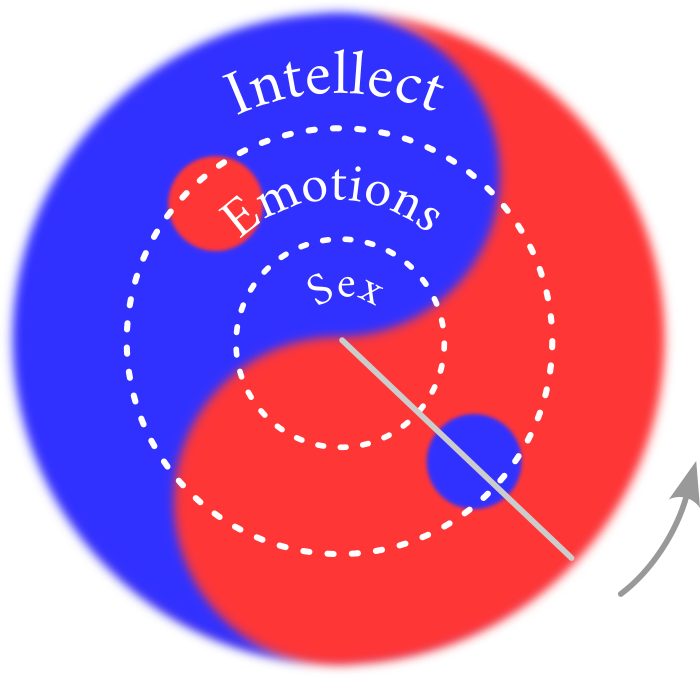
Fig. 1. Model of concentric levels of integration of psychosexual sphere (SEI cycle) and vector of the individual's position on the diagram.
The diagram shows three concentric levels of psychosexual organization: Sex (inner), Emotions (middle), and Intellect (outer). The fuzzy Yin-Yang background indicates complementary energies and a smooth, gradual transition from one polarity to another without sharp boundaries. The grey radius shows an example of the individual's current position, and the arrow shows the direction of development along the circle. The phase displacement arises as this radius moves along the arrow: during further rotation, the radius will capture the blue area (Yang) first at the sexual level, and only then at the emotional level.
Law of Phase Displacement of Levels
The basic psychosexual structure of a person possesses high stability. Its biological "hardware" is fixed, so the structure cannot change completely in a short period, but its development within certain limits is absolutely possible.
All three levels develop in a person at roughly the same rate, but they are separated in phase. The sexual level (S) usually outpaces the development of the other layers and goes ahead in phase. Similarly, the emotional level (E) outpaces the intellectual (I) in phase, but does not exceed it in absolute speed of changes. To be more precise, a straight radius rotates through the curved space of the circle. However, if a person is unbalanced, the radius begins to bend.
2. Semantics and Alphabet of Symbols in this Theory
To accurately describe vectors and sectors within this theory, a strict letter coding is used, combining body geometry and fundamental categories of being.
Geometric Markers of Principles:
- ia straight vertical line, symbolizing the male sexual organ (vector of force, outward direction, Yang principle).
- uan open receiving cup, visually resembling the female sexual organ (capacity, depth, Yin principle).
Categories of Scale Manifestation:
- LLaw, Information: The sphere of pure principles, rules, logical models, and structured information.
- SESubstance and Energy: The basic building blocks of the manifested world. The dense physical plane (Matter) and its dynamic charge (Energy) are combined in traditional sectors into an inseparable union (SE).
- ASpace: The sphere of cross-modal transitions, free space, where the rigid boundaries of polarities blur for a qualitative evolutionary maneuver.
Psycholinguistic Prefixes:
- Andro-(from Greek andros — man): indicates a focus of attraction or self-identification directed toward masculine manifestations, male qualities, and bodies.
- Gyno-(from Greek gyne — woman): indicates a focus of attraction or self-identification directed toward feminine manifestations, female qualities, and bodies.
3. Formation of the Psychosexual Structure
Deep sexuality and the architectonics of scales are formed in the perinatal period and partially in early childhood. This process occurs in accordance with an intuitive following of who the person (their essence) was in their past life.
Subconscious memory of past experience and the polarity fixed there leaves a fundamental imprint on the current biological form, determining the starting points of Balance and Mass in the SEI cycle.
4. Mechanics of Cyclic Development and Nature of Attraction
On the scale of personal identity evolution, it is not the phase asynchronous nature of levels itself that leads to a natural shift in polarities, but the gradual and sequential development of consciousness within the cycle. Asynchrony is merely a consequence of this process. At the boundary of global cyclic transitions, a temporary phase shift of vectors occurs:
Nature of Same-Sex Attraction:
When, during movement along the cycle, the internal settings have already changed at the physiological level (S), the mental and emotional attraction (E and I) still remain aligned with the former polarity. Due to this temporary lag, the person continues to be attracted to representatives of their current biological sex. Thus, homosexuality is a natural marker of a system transit state, when the biological form temporarily outpaces the psycho-emotional structure in phase.
Risks of Imbalance:
If a person practices exclusively physical contact, completely ignoring emotional (E) and intellectual (I) involvement, the S level goes too far ahead in phase and breaks away from the upper layers. A systemic imbalance arises, which temporarily blocks the harmonious integration of the personality.
5. Complementary Structure: Internal Balance of Yin and Yang
The interaction of partners is built on the mechanism of complementarity (completion). In order to understand a partner, a projection of the opposite principle gradually matures within our psyche — the Complementary Structure. As mature relationships develop, this structure in the brain and subconsciousness gradually increases in size (gains mass). It serves as an intuitive "interface" for reading and deeply understanding the reactions of the opposite sex.
This phenomenon is clearly reflected in the Yin-Yang symbol itself and is fully transferred to the logic of our diagram:
Inside the blue field of the Masculine principle (Yang), a contrasting red dot (Yin) grows and increases.
Inside the red field of the Feminine principle (Yin), a contrasting blue dot (Yang) grows and increases.
On the SEI cycle diagram, this internal balance is visualized as small contrasting circles of corresponding colors inside the main sectors. Upon reaching critical mass, the complementary structure harmoniously integrates into consciousness, shifting the perception of oneself and the partner to a qualitatively new level.
6. Six Sectors of Identity and Attraction Vectors
The division space of identity vectors is represented by six qualitative sectors that determine internal self-awareness and the direction of attraction.
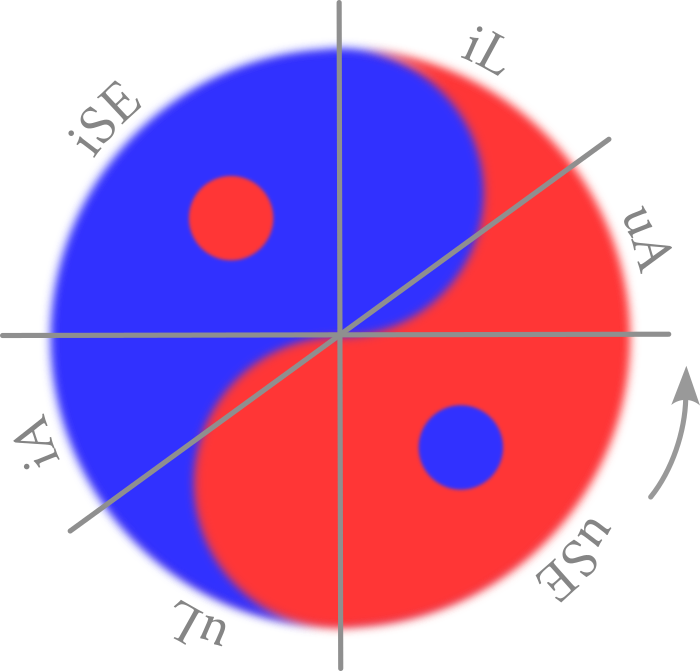
Fig. 2. Map of identity vectors: polarities of Yang (blue) and Yin (red) in the space of six psychotypes.
The map displays six psychotypes aligned along the core polarities. Each vector combines the internal self-awareness and attraction principles represented by the complementary balance of Yin and Yang energies.
iLAndrosexual Men (Gay Mode)
Complete identification with the masculine principle first at the sexual level, then at the emotional, and then at the intellectual level.
Attraction is directed towards men. Contact within the homogeneous Yang spectrum (blue) crystallizes masculine qualities, temporarily reducing the capacity of internal Yin components.
iSEHeterosexual Men (Traditional Mode)
Stable balance of the masculine pole (Yang).
Attraction is directed towards women of traditional orientation. Interaction is built on the classical polarity of principles.
iAGynosexual Men (Cross-mode)
Preservation of masculinity (Yang) on the E and I levels, but on the sexual plane (S) — partial identification with the feminine principle (Yin).
Possess high empathy and understanding of female physiology. Optimal partners for them are often androsexual women or representatives of the lesbian community.
uLGynosexual Women (Lesbian Mode)
Complete identification with the feminine principle first at the sexual level, then at the emotional, and then at the intellectual level.
Attraction is directed towards women. Mutual mirroring occurs, strengthening the femininity (Yin/red) of both partners. Mutual understanding is maximized due to equality of positions.
uSEHeterosexual Women (Traditional Mode)
Stable balance of the feminine pole (Yin).
Attraction is directed towards men of traditional orientation. Contact relies on the classic natural Yin-Yang polarity.
uAAndrosexual Women (Cross-mode)
High femininity (Yin) on the emotional and intellectual levels, but at the S level — capability to identify with the masculine principle (Yang).
Due to a developed complementary structure, patterns of initiative and dominance are close to them. They find deep mutual understanding with gynosexual men and representatives of the gay community.
7. Interpretation of Color Zones and Diagram Gradients
The result of the testing is a clear SVG diagram of eight sectors. Each dimension is determined by Mass (the radius of the sector, reflecting the overall strength of manifestation) and Balance (the smooth change of color hue from blue to red).
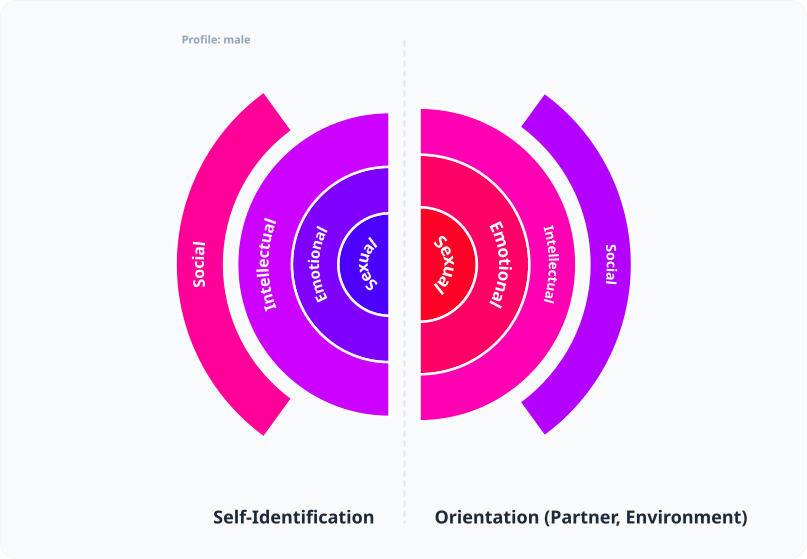
Fig. 3. Example of the test result - identity profile: mapping of internal self-awareness (Self-Identification) and attraction/orientation vectors (Orientation).
When blue (Yang) and red (Yin) mix on the diagram in equal proportions, they produce a deep neon-magenta hue. Its interpretation directly depends on the radius (Mass) of the investigated sphere:
Signifies a full synergetic mixing of both forces. This is a state of highest integration, in which in the chosen sphere of life the Masculine and Feminine principles are manifested simultaneously, proactively, and harmoniously, not suppressing but mutually reinforcing each other.
Points to their mutual absence, a decline in activity, or a transitional state of neutral "zero" before the start of a new impulse of development in the cycle.
8. Regular Identity Development in the Cycle
8.1 Bisexuality
Manifests in situations where at some levels a person is attracted to one pole, and at others — to the opposite. Rigid boundaries between polarities here are partially blurred, which allows for comfortably experiencing attraction to partners of different sexes and engaging with them.
Much depends on current self-identification: as the complementary structure grows, a temporary internal sense of confusion can arise ("who am I and which vector is closer to me?"), because the main levels and compensatory projections possess different volume and mass. These intermediate options of potential distribution are laid down in the perinatal period and childhood in the process of intuitive following of past incarnations' experience.
8.2 Transsexuality as a Vector of Evolutionary Development (Cross-modal)
This phenomenon manifests not merely as a spatial mismatch between physical body morphology and the spirit vector at birth. Within this theory, transsexuality is viewed as a regular, dynamic development of personality through Cross-modal states in the cycle.
Moving along the evolutionary spiral, consciousness continuously accumulates experience. When the stage of transition from one polarity to another arrives, the system utilizes the Cross-mode as a necessary evolutionary bridge. The sexual level (S), being the most plastic, is the first to make a qualitative shift in the cycle and begins to totally identify with the opposite principle, while the more massive mental layers (E and I) still retain the former pole. Transsexuality in this concept is the maximum, concentrated manifestation of cross-mode, where the personality, through a deep internal challenge, rapidly lives through, develops, and increases the complementary structure of the opposite sex to enter a completely new turn of Yin-Yang balance.
9. Conclusion: From Rigid Dogmas to Dynamic Equilibrium
The concept of the SEI cycle shifts the understanding of human identity and attraction from outdated static frameworks to a course of dynamic, continuous development. It offers a fundamentally new, depathologized view of the inner world of a human. Complex questions of self-determination, features of same-sex attraction, manifestations of bisexuality or transsexual transit are viewed here not as system failures or errors, but as natural, regular stages of personality evolution within a single Yin-Yang cycle.
Key conclusions of the concept:
-
Reconciliation of Biology and Psyche:Relying on the stable biological "hardware" of the body, the theory explains internal crises through the natural phase shift of sexual, emotional, and intellectual levels. This removes the burden of internal stigmatization from a person and helps to understand the logic of their own feelings.
-
Cross-states as a Consequence of Evolution:Bisexuality and transsexuality are revealed not as the root cause or culprit of internal changes, but as a regular consequence of the gradual development of consciousness within the cycle itself. They represent external cross-modal markers through which the self-complicating system at the interface of phases visually demonstrates the process of polar experience integration.
-
Intuitive Path to Harmony:The model emphasizes that the deep sexual architectonics laid down in the perinatal period as a reflection of the experience of past incarnations develops not chaotically, but obeys a strict circular motion towards balance.
-
Growth through Complementarity:The development of personality and the success of a union directly depend on the gradual increase in the mass of the complementary structure — the internal "interface" that allows partners to intuitively understand and deeply feel each other.
Summary for the User
The multidimensional graphical chart that the user receives as a result is not just a static snapshot of their orientation. It is a map of the current distribution of potential, balance, and mass of their internal levels and sectors. It visually proves that every person is a unique, living gradient of blue (Yang) and red (Yin) colors.
The ultimate goal of the SEI model is to help the individual realize their unique architectonics, overcome painful desynchronization of levels, and balance them among themselves. The task of a person is not to "average" themselves to a homogeneous neon-magenta state, erasing their individuality, but to bring internal order to the phases of development of their "Self". It is this alignment of scales that relieves internal tension, allowing a person to unlock their true potential, meet a co-directed partner, and live a full, rich, and happy life.